
Time is Ticking! How DNA Methylation is Cell Specific and Has Connections with Aging
Aging is a phenomenon that affects everyone, and DNA methylation analysis might give insight on the effects of aging. Roy et al. analyzed DNA methylation data to determine that DNA methylation patterns in immune cells are cell specific and related to hypoxia and inflammation.
By: Isabelle Meyers
Contact the author at izmeyers@davidson.edu
Disclaimer: This web page was produced as an assignment for an undergraduate course at Davidson College
Thumbnail photo courtesy of Sony on Unsplash
Aging is a phenomenon that occurs in everyone, so it is no surprise that it is a heavily studied topic. One way to study aging is through epigenetics, the study of changes in gene function due to inherited or non-inherited changes that do not alter the DNA sequence1. One epigenetic mechanism is DNA methylation, which is when a cytosine (one of the four DNA nucleotide bases) obtains an extra methyl group (CH3), which usually blocks proteins from “reading” that DNA2. These changes in DNA can lead to adverse health effects.
Previous studies investigated DNA methylation and aging, but they used mixed blood cell samples. This makes it difficult to pinpoint DNA methylation changes in certain cell types, and these studies failed to connect aging and DNA methylation changes.
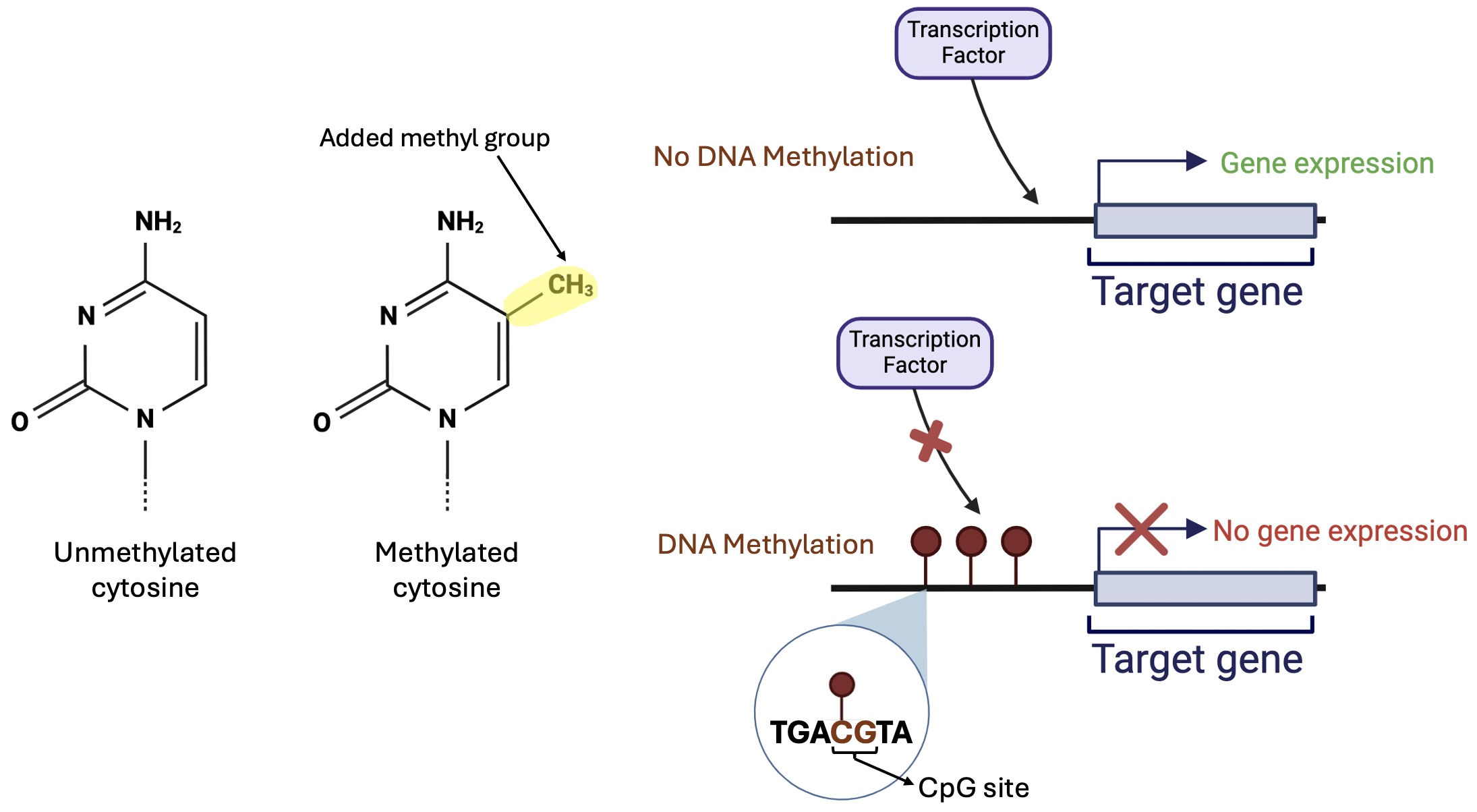
On right: Schematic of a transcription factor trying to bind to DNA without (top) and with (bottom) DNA methylation. Zoomed-in region at bottom shows a CpG site.
Roy et al. wanted to investigate cell-type specific age-associated methylation in the hopes of forming connections between DNA methylation and aging3. To do so, they obtained blood cell samples from donors ages 22 to 83 years. They then separated the blood cells into six immune cell groups, with each group being a different type of immune cell. These six groups were used for all cell specific experiments. All donors were healthy to minimize any confounding variables that could alter findings.
Roy et al. first identified any CpG sites that were differentially methylated with aging in multiple cell types. CpG sites are the most commonly methylated locations in the DNA sequence where a cytosine base (C) is followed by a guanine base (G). The researchers found that most age-related methylation site changes were cell specific, meaning that the changes were not consistent between cell types, but were similar among the specific cell groups. They did identify 181 age-associated hypomethylation sites (sites where there was less methylation than predicted) and 169 hypermethylation sites (sites where there was more methylation than predicted) which were shared across cell types. These numbers were significantly more than expected based on chance alone, meaning there are common epigenetic mechanisms across immune cell types.
Since Roy et al. identified CpG sites of interest, they wanted to observe these sites over time. They gathered longitudinal data (data taken from the same participants over a span of many years) for each of the six immune cell types and observed changes in methylation patterns. They found that these sites were indeed differentially methylated across cell types and ages, supporting the idea that DNA methylation is not only cell specific, but also age specific.
The question arose that, if there were all these changes in methylation status, then why did the previous studies that used mixed populations not find these differences? To answer this question, Roy et al. looked at each methylation site and compared it among cell types within the same age group. They saw that some cell types have a hypermethylation, while another has hypomethylation, in the same spot. While this supports the idea that each cell type has a different methylation pattern, it also means that these differences can “cancel out” when bunched together in a mixed sample, explaining why mixed sample studies yielded ambiguous results.
Roy et al. was interested in learning more about these hypo- and hypermethylated sites. They performed gene set enrichment analysis, which determines what types of genes are more active than usual in a particular sample. They found that the hypomethylated genes were involved in collagen biosynthesis, the complement cascade, and GTPase pathway. These pathways are involved with inflammation and metabolism, common issues that arise in older people. The hypermethylated genes were involved with neural and G-protein-coupled receptor pathways, both of which are connected to diseases like Alzheimer’s4.
Now that certain cellular processes were identified as being differentially expressed in hypo or hypermethylated regions, Roy et al. investigated whether there were specific transcription factors binding these DNA methylation sites that could explain the gene activity. Transcription factors are proteins necessary for gene expression, and each transcription factor usually binds only to a specific sequence in the DNA. Roy et al. used computer programs to identify these transcription factor binding sites and identified multiple transcription factors that had increased activity in certain age groups. Interestingly, these transcription factors were involved in hypoxia and inflammation responses, common problems for the aging population.
All together, Roy et al. concluded that age-associated DNA methylation is mostly cell specific, but shared sites are involved in pathways related to hypoxia and inflammation. However, only immune cells were investigated in this study, so these findings may not apply to DNA methylation in other tissues. Furthermore, there have been previously mentioned sex-biases in aging, and the data in this study was not separated to identify such biases5. It would be beneficial to separate the men and women samples and see if there are any differences between the groups.
Additionally, since epigenetic markers can be heritable or not, it is important to look at different environmental conditions and lifestyles. These differences can appear in epigenetic studies, and so scientists must be sure to sample a wide diversity of people to get results that best fit a population. This means there must be great care taken to ensure that no group is underrepresented and that data is analyzed in an unbiased way to prevent over-assumptions and discrimination purely based on epigenetic markers. Age discrimination is a common issue, and so care must also be taken to prevent this from occurring when discussing data related to aging.
References
1. Dupont, C., Armant, D. R. & Brenner, C. A. Epigenetics: Definition, Mechanisms and Clinical Perspective. Semin. Reprod. Med. 27, 351–357 (2009). Article
2. Moore, L. D., Le, T. & Fan, G. DNA Methylation and Its Basic Function. Neuropsychopharmacology 38, 23–38 (2013). Article
3. Epigenetic signature of human immune aging in the GESTALT study | eLife. https://elifesciences.org/articles/86136. Article
4. Dal Prà, I., Armato, U. & Chiarini, A. Family C G-Protein-Coupled Receptors in Alzheimer’s Disease and Therapeutic Implications. Front. Pharmacol. 10, (2019). Article
5. Hägg, S. & Jylhävä, J. Sex differences in biological aging with a focus on human studies. eLife 10, e63425. Article

I think that your follow through and breakdown of the methods employed by Roy et al. was very succinct and clear. I can appreciate the ease with which you broke down the basics of methylation as well as covered the population of interest for the study. Similarly, I like the way you state the possible questions the researchers may have had as their research developed and the study was narrowed to gene enrichment analysis.
Your final thoughts on employing more diverse sampling in order to reduce bias within datasets is very appropriate. I would agree, as many genetics studies lack significant coverage within samples for the population of interest.
I really enjoyed how you explained and presented the data from this study! I am very interested in the different factors that impact aging and how they can be observed phenotypically. While this study only focused on immune cells, I think future studies looking at methylation patterns in neurons may be useful in providing insight about some cognitive trends associated with age. For example, psychologists have observed a “general slowing” in older adults, even those with no neurological disorders like Dementia. Could DNA methylation impact how someone’s cognition changes as they age? Can we predict the course of cognitive slowing that someone will undergo based on their neuronal methylation patterns?
Hi Izzie, thanks for the great insights on age-related epigenetic changes. Did the authors provide any commentary on their findings related to complement cascade protein expression? I find it very odd that immune cells in the periphery had differentially methylated genes for the complement cascade, considering that the bulk of those proteins are secreted by hepatocytes.
I definitely agree with your thoughts on getting samples from individuals from more diverse environments. Since epigenetic regulation is perhaps the main way through which the environment affects the phenotype, it’s definitely important to get as many diverse samples as possible to make sure we can generalize our findings.
Hey Izzie, thanks for writing this concise and clear insight on the relationship between aging and DNA methylation. I was interested to see how the DNA methylation studies we talked about in class have implications for aging. I wonder how these findings of DNA methylation in immune cells will relate to other tissues, as the study was primarily focused on immune cells. I also agree with the importance of collecting samples from different environments as it is important to see if the findings are consistent throughout.