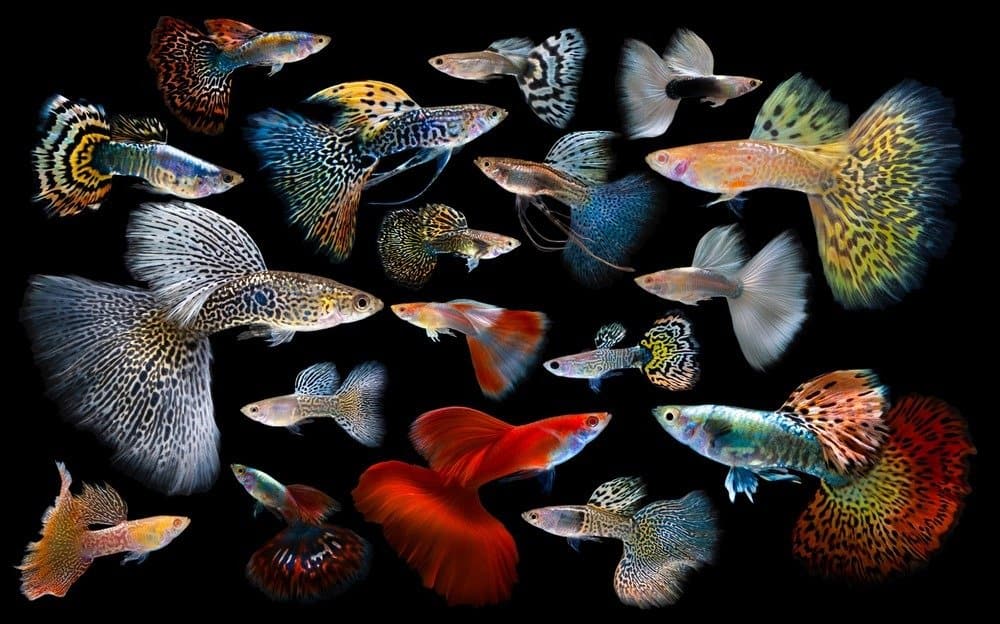
Fish schooling offers a useful model for examining the genetic makeup of affiliative behaviors and analyzing the mechanisms underlying these species’ social behaviors and personality traits.
This web page was produced as an assignment for an undergraduate course at Davidson College.
Many animals across the animal kingdom develop complex social behaviors that seem to be mind blowing. A great phenomenon is sociability, which represents a fundamental aspect of personality which can influence social behavior and is subject to strong selective processes. Researchers have concluded that heritability estimates of social behavior traits are consistent with a complex polygenic architecture or the genetic basis of a trait/phenotype that is influenced by the combined effects of multiple genes (Hindorff). Studies have shown that in non-human organisms, genes are involved in the regulation of neurochemical systems. Human twin and family studies reveal that heritability estimates of personality traits around 0.4, the closer to one signifies more heritability. Non-human analysis estimates heritability around 0.23 across behaviors including personality. In other words, personality traits are seen to be heritable.
Despite this complexity, there are other factors that contribute to social behavior such as multiple neural and genetic mechanisms. Neural structures and neuromodulators or serotonin, dopamine, and oxytocin remain unchangeable throughout networks across vertebrates. It has been found through studies that non-human organisms play a major role in genes involved in the regulation of these neurochemical systems. We lack a deeper understanding of the role of genes in inter-individual variation and evolutionary processes underlying sociability.
The study taken Functional convergence of genomic and transcriptomic architecture underlies schooling behaviour in a live-bearing fish aim was to understand the role of inter-individual variation and evolutionary processes underlying sociability by using fish more specifically guppies. In fish groups, group living leads to forms of collective behavior where members coordinate their movements.T o understand the genetic basis of the schooling phenotype, researchers needed to link individual phenotypic differences to genetic variation.
They did this by phenotyping alignment and attraction of 1496 guppies across 195 families to estimate the heritability of motion characteristics. Researchers were examining cross-sex genetic correlations in ecologically relevant behavioral traits; since guppies have sex differences in social interaction patterns. Furthermore, they also sequenced DNA pools (pool seq) to identify genome wide differences in allele frequencies between polarization-selected female guppies that presented high sociability and female guppies that presented low sociability. Polarization is the level of alignment between individuals moving together, in this paper this is considered a phenotype.Researchers also used RNA sequencing to determine differences in gene expression in multiple brain regions of polarization selected and controlled females in response to two different social contexts. RNA sequencing allows to reveal the presence and quantity of RNA in a genome(Mackenzie). The social contexts consisted of either swimming alone or swimming in a schooling group with unfamiliar female individuals .
In fish group living leads to forms of collective behavior with members of school coordinating their movements to increase efficiency in foraging, traveling or predator avoidance. How they coordinate their movements is an integral part of sociability and their personality as that is how these individuals present themselves in the presence or absence of their species. Understanding schooling requires the understanding of genetic basis in the phenotype that links to individuals and differences in genetic variation. First researchers determined whether experimental evolution for higher schooling affected social interacting with unfamiliar conspecifics ( belonging to the same species).For this strategy they assessed sociability in 740 females and 746 males from multiple families of 3 replicate lines selected for average higher polarization and 3 replicates exposed to conspecifics in an open field; female guppies from polarization selected lines presented higher alignment and attraction to an unfamiliar group compared to control lines.There was no differences seen in traits between polarization selected and control males. There were some differences in sociability between parental and offspring generations. These results could be explained through the differences between body size age classes in guppies.
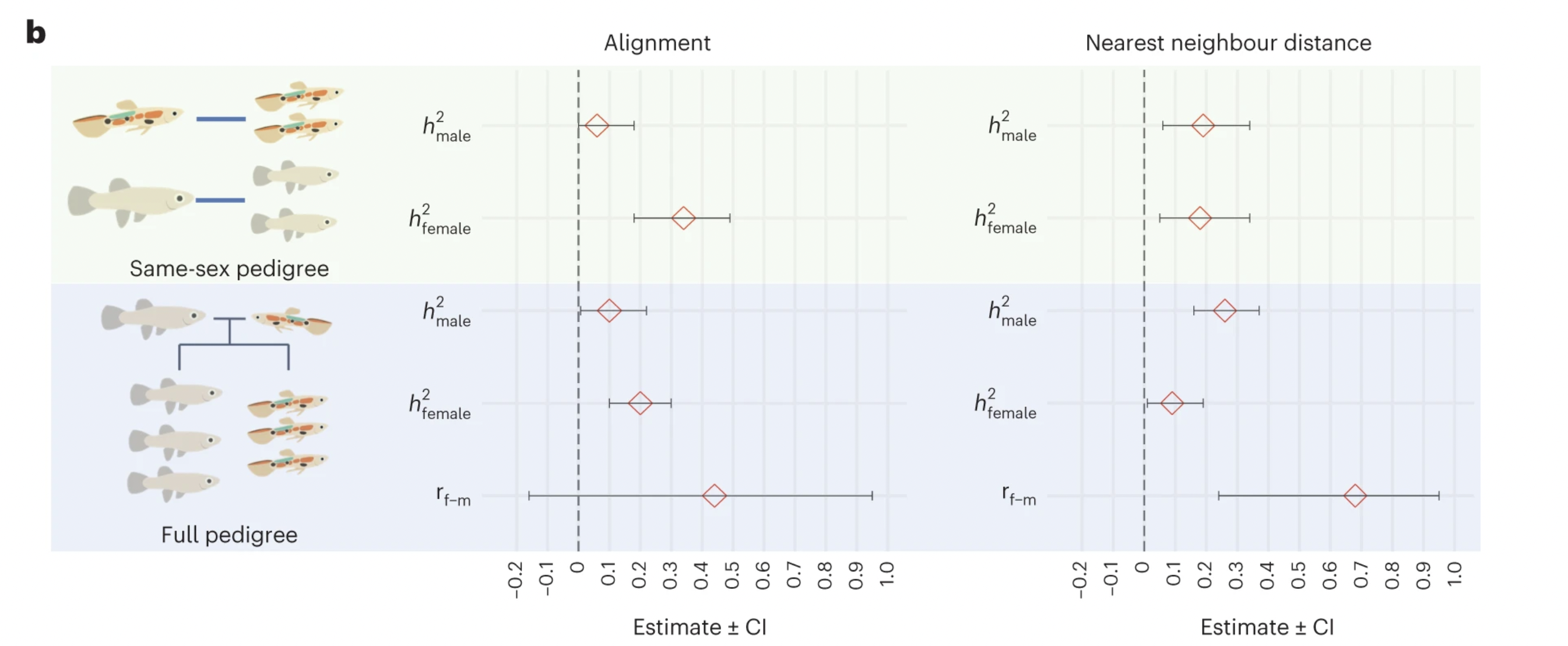
To assess the heritability of sociability in these species researchers fitted an animal model with alignment and attraction phenotypes quantified from these 1486 individuals. Given the known sex-differences in these individuals, heritability was estimated with animal models that only included relationships between same-sex individuals such as same sex pedigrees and relationships between individuals from both sexes (full pedigree)The animal models (fig B) indicated a positive female-male genetic correlation in attraction.
Researchers also used transcriptome sequencing (RNA-seq) to determine differences in gene expression in multiple brain regions of polarization- selected and controlled females in response to two different contexts which were swimming alone or schooling in groups. Researchers focused on the optic tectum (sensory processing of visual signals) and the telencephalon which is responsible for decision making. Additionally, the midbrain was also looked at which is associated with motor function in response to auditory and visual stimuli. Together these three parts of the brain make up the main components of social aspects in the brain of fish. In order to analyze the results, researchers identified genes expressed under each treatment condition (swimming in schools or alone) and in each brain region to quantify the neurogenomic response triggered by schooling.
In conclusion, through the broad range of analyses, spanning genomes, transcriptomes and phenotypes researchers work suggest that genes and gene networks involved in social decision making are key in the evolution of schooling in fish. Moreover through the pedigree that was performed by researchers, it suggests heritability in personality traits. Some limitations that were definitely seen throughout the paper is that it was difficult to precisely characterize cross-sex genetic effects in the study, leaving out how sex can vary in heritability. Moreover, the many given range of analyses such as pool-seq, rna-seq and phenotyping analysis made it difficult to conclude a precise conclusion as there were so many factors taken into account from the various types of analyses being taken. It is essential to understand behavior in genomics as we better assess mental illnesses and preventative medicines to help individuals.
References:
- Corral-Lopez, A., Bloch, N.I., van der Bijl, W. et al. Functional convergence of genomic and transcriptomic architecture underlies schooling behaviour in a live-bearing fish. Nat Ecol Evol 8, 98–110 (2024). https://doi.org/10.1038/s41559-023-02249-9
- Hindorff, Lucia. “Polygenic Trait.” Genome.Gov, 2024, www.genome.gov/genetics-glossary/Polygenic-Trait.
- Mackenzie , Ruairi. “RNA-Seq: Basics, Applications and Protocol.” Genomics Research from Technology Networks, 2024, www.technologynetworks.com/genomics/articles/rna-seq-basics-applications-and-protocol-299461.
© Copyright 2022
Department of Biology, Davidson College, Davidson, NC 28036

Hey Johana!
The finding that control males behaved similarly to polarization-selected lines while females showed a difference is intriguing. This gender-specific response could stem from differences in social roles or mating strategies between male and female guppies. Exploring whether the genes implicated in fish social behaviors have human homologs is an exciting avenue for research. However, it’s important not to label genes as inherently “good” or “bad” as they play complex roles influenced by various factors. Doing this research could also ostracize certain groups of people. Understanding these nuances is vital to interpreting their impact on behavior in both fish and humans. Overall, I really loved the topic and I believe this type of research can be really insightful.
Hey Johana!
The finding that control males behaved similarly to polarization-selected lines while females showed a difference is intriguing. This gender-specific response could stem from differences in social roles or mating strategies between male and female guppies. Exploring whether the genes implicated in fish social behaviors have human homologs is an exciting avenue for research. However, it’s important not to label genes as inherently “good” or “bad” as they play complex roles influenced by various factors. Doing this research could also ostracize certain groups of people. Understanding these nuances is vital to interpreting their impact on behavior in both fish and humans. Overall, I loved the topic and believe this type of research can be really insightful.