In a world where artificial intelligence is all around us, how can we harness this technology to aid health outcomes? A talented group of scientists attempt to answer this question by creating a novel machine learning algorithm that could potentially mark the beginning of a new era of non-invasive cancer diagnostic tests.
This web page was produced as an assignment for an undergraduate course at Davidson College. Link to homepage
Cancer remains a leading cause of mortality worldwide, second only to heart disease (Chakraborty, S., & Rahman, T., 2012). It’s a complex group of diseases, with over 200 variants, each affecting the body differently. One of the main challenges in cancer treatment and management is its heterogeneity — each case manifests uniquely, complicating diagnosis and treatment. Moreover, cancer’s resistance to current therapeutic drugs and the absence of reliable biomarkers for early detection further complicate the medical community’s efforts to combat this disease. Despite these obstacles, advances in technology and biology are poised to transform cancer diagnostics and patient care.
Mitosis, the process through which cells divide, is fundamental to growth and development. In cancer, this process becomes dysregulated, leading to uncontrolled cell proliferation and tumor formation, which can develop in various body tissues. Traditionally, cancer diagnosis has relied heavily on biopsies—extracting a small tissue sample from a tumor and examining it for cancer cells. While effective, this method can be invasive and is not always feasible, especially for tumors in hard-to-reach areas. Enter the concept of liquid biopsy, a revolutionary approach that uses biological fluids like blood or urine to detect cancer. This method looks for circulating tumor DNA (ctDNA), circulating tumor cells (CTCs), and exosomes, offering a less invasive diagnostic alternative.
Exosomes, small extracellular vesicles released by cells, are at the forefront of a recent study (Li et al, 2023). These molecular entities are involved in various physiological processes and diseases, including cancer (Kalluri, R., & LeBleu, V. S, 2020). They contain a slew of proteins, DNA, RNA, and other molecule. These biological molecules show promise as potential candidates for early cancer detection and monitoring in a non-invasive manner.
Li et al. developed a novel machine learning-based approach to analyze exosome proteins, using a supervised learning algorithm known as a random forest model. Their research utilized multiple datasets of exosomal proteins from various sources including cell lines, tissue, plasma, serum, and urine. They first analyzed exosome proteins solely in cell-line derived samples. They identified 18 plasma membrane proteins as significant biomarkers for cancer. Later on, they incorporated data from tissue-derived exosomes to mark five plasma membrane proteins that are found across both cell-line derived samples and tissue-derived samples: CLTC, EZR, TLN1, CAP1, and MSN. By incorporating both sample types, they underscored the potential of exosomal proteins to work as biological markers.
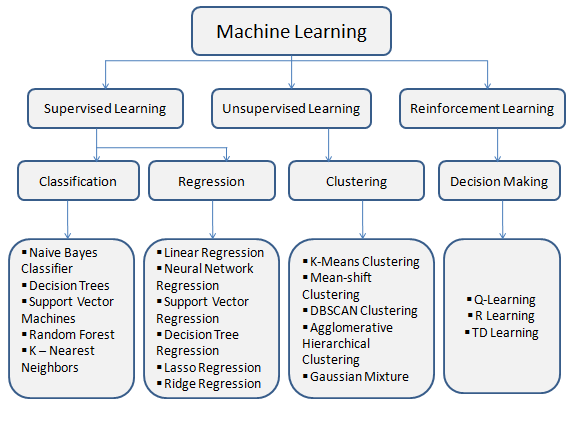
Image from https://www.analyticsvidhya.com/blog/2021/03/everything-you-need-to-know-about-machine-learning/
As stated before, Li et al used random forest classifier, a type of machine learning algorithm. Machine learning is just what it sounds like – computers are fed data which they then analyze to make predictions in a process akin to learning. The associations that computers make are beyond the ones that we as humans can make, which highlights the benefit from this technology. In supervised learning, the model is fed labeled data as opposed to unlabeled data. In other words, the model is trained using categorized labels. Using the relationship it can draw from its training, these models can then categorize inputs it has not seen before.
This team trained their models using identified protein biomarkers and their respective mutual information scores (MI scores). MI scores are a quantification of shared features between an independent and target variable, with higher scores indicating greater association. In this context, the independent variables were the biomarker proteins while the 2 target variables, or labels, were either “cancerous” or “non-cancerous”. A higher MI score singles a protein out as being particularly informative of cancer status.
Researchers created three separate models in the study. The first model was trained using 18 protein biomarkers, coming from plasma/serum samples, to distinguish whether an exosome sample was cancerous or not across varying cancer types. The second model was a refinement of the first – it was trained using 5 protein biomarkers (also in plasma/serum samples) to distinguish between five common types of cancer (breast cancer, colorectal cancer, glioma, lung cancer, and pancreatic cancer). The last model used a set of 17 protein biomarkers unique to urinary exosomes to distinguish between cancerous and non cancerous exosomes. All models yielded high accuracy scores – 92%, 94%, and 90% respectively. By using urinary, plasma, and serum samples, researchers demonstrated how their method can be applied to any of these three easily accessible samples.
The interdisciplinary approach adopted by Li et al., combining machine learning with exosomal protein analysis, represents a significant step forward in cancer diagnostics. Their method holds promise for developing more accessible, less invasive diagnostic tools, potentially transforming cancer care by enabling early detection and personalized treatment strategies. Like with most diseases, early detection of cancer results in higher survivability (Crosby et al., 2022). Current diagnostic tests can be socially, economically, and mentally taxing on the patient. This group’s findings offer a potential solution by making diagnostic tests less invasive and more accessible.
This team focused on one particular kind of machine learning type: supervised learning. There are other types of algorithms that exist, and future studies could play around with them to create different models. In particular, deep learning is an extremely powerful type of machine learning that is efficient at interpreting large amounts of data and has achieved impressive results in other domains. Furthermore, this study made no mention of the ethical implications of using artificial intelligence in clinical settings. This is a controversial topic, and future research should explore the social ramifications of this new diagnostic tool. Lastly, investigating the application of these methods to include less common cancer types could further validate the utility of these methods and improve their predictive power.
This article was written by Carlos Jaramillo. Please reach out at cajaramillo@davidson.edu
References:
- Chakraborty, S., & Rahman, T. (2012). The difficulties in cancer treatment. Ecancermedicalscience, 6, ed16. https://doi.org/10.3332/ecancer.2012.ed16
- Li Bingrui, Kugeratski Fernanda G., Kalluri Raghu (2023) A novel machine learning algorithm picks proteome signature to specifically identify cancer exosomes eLife 12:RP90390 https://doi.org/10.7554/eLife.90390.1
- Kalluri, R., & LeBleu, V. S. (2020). The biology, function, and biomedical applications of exosomes. Science (New York, N.Y.), 367(6478), eaau6977. https://doi.org/10.1126/science.aau6977
- David Crosby et al. Early detection of cancer. Science 375, eaay9040(2022).DOI:10.1126/science.aay9040
© Copyright 2022 Department of Biology, Davidson College, Davidson, NC 28036.

Amazing work, Carlos! Your post was very insightful in highlighting the innovative use of artificial intelligence in cancer research, particularly in identifying exosome proteins to differentiate between cancerous and non-cancerous cells. I also like your observation that the paper did not mention anything about using AI, which was interesting. Given the ongoing debate surrounding AI, it would have been valuable to read the researchers perspective on its application in clinical settings and where they see their future research going with this. Once again, your description of the research project, and your highlighting of ethical concerns was fantastic! Good job.
Hey Carlos I really liked how you summarize your article! It is very interesting that the scientists were able to identify proteins as significant markers for cancer. I also liked how you emphasized that the methods the researchers developed enable early detection as it can be very hard especially in pancreatic cancer. I agree with you that limitations should be emphasized, particularly in this study as cancer affects so many people around the world.
I found your article and way of writing very concise and clear. I was initially interested in your article since both of our’s deal with machine learning, and I think it is interesting to learn that not all machine learning will work the same. While the paper I looked at was studying the machine learning capacity for detecting the progression of a disease, while your paper looked at the detection of cancer. This is a topic I am particularly interested in since (too many) of my family members have had some sort of cancer. It is fascinating to me to learn that now you can detect cancer through non-invasive mechanisms, and honestly as much as I am squeezing my brain to find something to discuss from this paper I cannot.
I like the comprehensive information you provide in your blog. The topic is kinda complex but I’d have to say you nailed it! Look into my page ZH5 for content about Airport Transfer.