Read more about the author of this post here.
This web page was produced as an assignment for an undergraduate course at Davidson College.
Recently, researchers at the Shenzhen Key Laboratory have worked to unveil the molecular basis of cancer cell heterogeneity. Their data reveal that copy number variations and epigenetic variation are responsible for intra-cancer-cell-line variation which may give way to new cancer pharmaceuticals in the future.
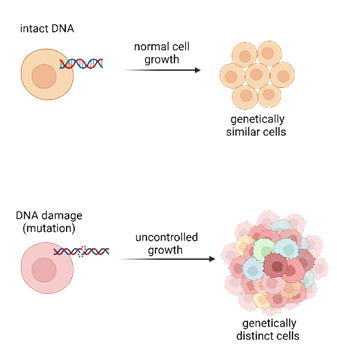
Cancer starts when there is a harmful mutation within the DNA of a cell that leads to uncontrolled cell growth, or what is known as tumorigenesis. Oftentimes, these tumor cells progress to become more aggressive and resistant to intrinsic biological processes that can typically kill uncontrolled cells. Part of the reason why tumor cells are so resistant and aggressive is due to intra-cell-line heterogeneity (McGranahan and Swanton 2017). In a normal cell line, all cells are genetically identical and carry out the same function within a given tissue. However, in cancer cell lines, cells divide rapidly and transform to be more genetically distinct from one another. The underlying mechanisms behind why cancer cells remain relatively heterogeneous remain poorly understood. Researchers Zhu, Zhao, Zhang, Li, and Liu use both scRNA-seq and scATAC-seq on dozens of human cancer cell lines to answer the question of how cancer cells transform to be genetically distinct from one another (Zhu et al. 2023).
First, the researchers decided to do single-cell RNA sequencing (scRNA-seq) on 40 different human cancer cell lines and 2 normal human cell lines as a control. scRNA-seq data helps show which genes are expressed differently among different cell types, which can explain some of the heterogeneity within cancer cell lines. When they computationally analyzed their scRNA-seq data they found that gene expression within cell lines could be categorized into either a discrete or continuous pattern. Discrete cells showed a more distinct clustering pattern whereas continuous cells gradually differed from one another. Discrete cells also contributed more to gene diversity meaning that cancer cell heterogeneity is driven primarily by cells being more dramatically distinct from one another (in terms of gene expression) rather than differing on a gradual continuum.
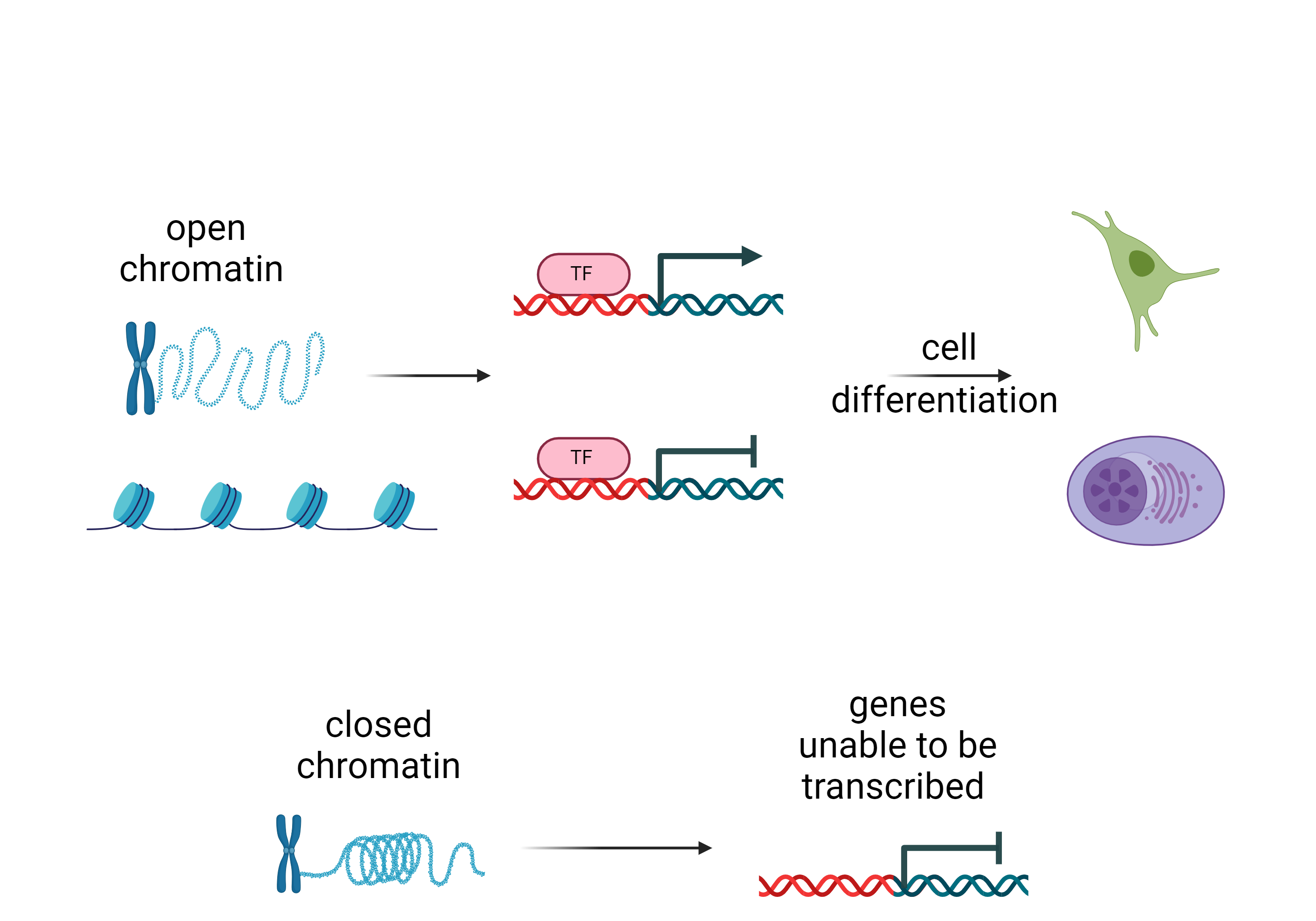
After performing scRNA-seq on the 40 human cancer cell lines, the researchers decided to perform scATAC-seq to characterize the epigenetic modifications, or modifications that change gene expression, but don’t change DNA sequence, that may also drive cancer cell line heterogeneity. Each cell has a tissue-specific chromatin landscape, or spatial organization of DNA within a cell, that can lead to distinct gene expression patterns. scATAC-seq is used to evaluate where open and closed chromatin sites are located within a specific cell. They found that cancer cells continued to cluster into the previously defined discrete and continuous clustering patterns based on chromatin accessibility features. Most cells (62%) showed a discrete clustering pattern which shows that distinct chromatin accessibility features within cell lines contributes to a portion of the cancer cell-line heterogeneity. Large-scale copy number variations (CNVs), or sequences in the genome that repeat a variable number of times, were also inferred from their scRNA-seq data using a computational program. These CNVs were found within 25 of their 40 cancer cell lines and were heavily correlated with differentially expressed regions in the genome (areas where gene expression was either significantly higher or lower when compared to a control). Chromatin accessibility features and differential gene expression were not correlated, however, displaying that chromatin state and gene expression through CNVs both work independently to contribute to intra-cancer-cell-line heterogeneity.
Zhu et. al’s discovery that both epigenomic marks such as chromatin accessibility and differential gene expression both work to increase cancer cell line heterogeneity is revolutionary as it provides us a deeper understanding of the molecular mechanisms of tumorigenesis. These findings are increasingly important as we search for therapies for various cancer types. Precision therapies may be need to rethought in order to target all cancer cells, even if they are genetically distinct.
While this study furthers the field of cancer biology, unfortunately the scope what cancers these results can be applied to is somewhat limited. The researchers chose to focus on colorectal and breast cancer cell lines for deep analysis, but other cancer cell lines may behave entirely differently to these two cancers. Future studies using similar methods such as scRNA-seq and scATAC-seq need to be done in other cancer cell lineages to illuminate whether or not all cancer cell lines behave heterogeneously. Additionally, breast cancer is the highest funded cancer type, receiving 11.2% of all cancer funding from 2016-2020 (McIntosh et al. 2023). However, other kinds of cancer with high mortality rates, such as colorectal (which the researchers did study) and pancreatic cancer are underfunded. Unfortunately, cancer research funding is disproportionately skewed to certain cancer types, leaving cancers that affect Black patients at a higher rate underfunded (Kamath and Chen 2024). It is important that cancer researchers and larger organizations such as the National Cancer Institute and National Institutes of Health continue to research and fund all cancers equally. Endeavors to increase scientific discovery in underfunded cancer types are paramount to stopping racial health disparities that continue to perpetuate throughout our medical system today.
Works Cited
Kamath S. D., and Y. Chen, 2024 Disparities in National Cancer Institute and Nonprofit Organization Funding Disproportionately Affect Cancers With Higher Incidence Among Black Patients and Higher Mortality Rates. JCO Oncol Pract 20: 378–385. https://doi.org/10.1200/OP.23.00126
McGranahan N., and C. Swanton, 2017 Clonal Heterogeneity and Tumor Evolution: Past, Present, and the Future. Cell 168: 613–628. https://doi.org/10.1016/j.cell.2017.01.018
McIntosh S. A., F. Alam, L. Adams, I. S. Boon, J. Callaghan, et al., 2023 Global funding for cancer research between 2016 and 2020: a content analysis of public and philanthropic investments. The Lancet Oncology 24: 636–645. https://doi.org/10.1016/S1470-2045(23)00182-1
Zhu Q., X. Zhao, Y. Zhang, Y. Li, S. Liu, et al., 2023 Single cell multi-omics reveal intra-cell-line heterogeneity across human cancer cell lines. Nat Commun 14: 8170. https://doi.org/10.1038/s41467-023-43991-9

A wonderful introduction to understanding the varying cell line complexity and heterogeneity of cancer, Jada! I agree that the limiting factor of only analyzing colorectal and breast cancer cell lines may not be applicable to many other cancer types, but hopefully the findings for these specific cancers can provide insight to better precision therapy. I do wonder why cancer research continues to be disproportionately funded. With cancer severity and mortality varying so much between different cancer types, it truly becomes an ethical concern when determining which research should be done next and how to balance funding for varying cancer types.