“This web page was produced as an assignment for an undergraduate course at Davidson College.”
About the author: John Ready
Believe it or not, spiders weren’t always aerial web-building arachnids. Through a single-cell transcriptomics approach, Jin et al. investigates how the the nervous system of web-building spiders evolved, shedding light on the molecular basis of their complex behaviors.
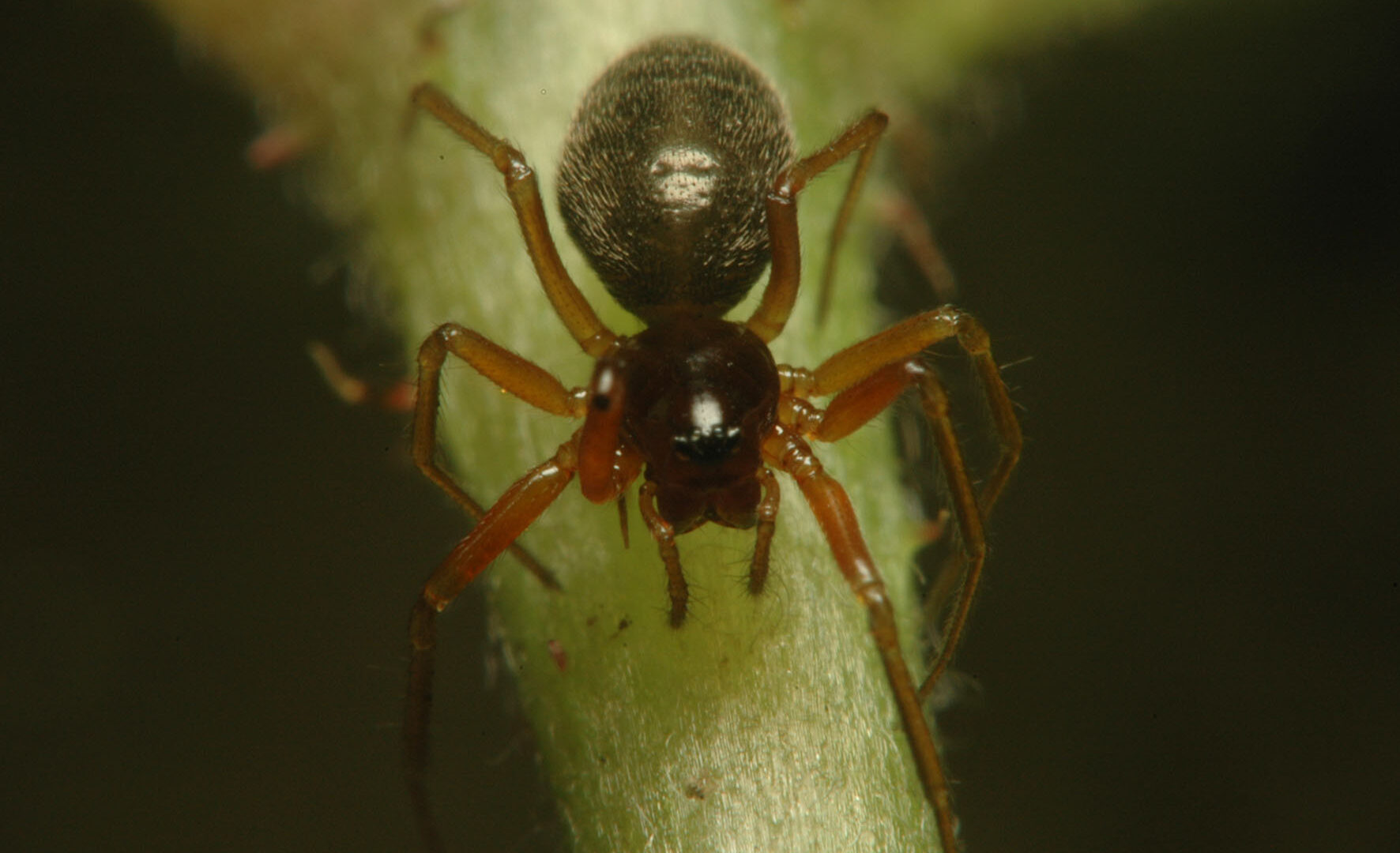
For many the simple thought of a spider crawling about its web sends shivers down their spine. This common fear leads many to overlook spiders as complex and calculated creatures. Despite their menacing appearance, spiders are truly remarkable organisms capable of constructing intricate structures with their silk. Spiders originated during the Devonian period, roughly 372 million years ago, as land-dwelling critters who created burrows lined with silk1. As the environment and availability of resources changed, including an increase in flying insects, a subset of spiders evolved a new behavior to utilize their silk material to construct aerial webs2. Despite the understanding of the behavioral evolution in web-building spiders, questions remained about the underlying changes in the brains of spiders that led to this evolved hunting strategy. Writing in Nature Ecology and Evolution, Jin et al.3 sought to answer these questions by investigating how the nervous system of Hylyphantes graminicola, a web-building spider, evolved alongside the adapted aerial web hunting strategy. They then compared these results to that of land-dwelling spiders.
To provide answers, Pengyu Jin and colleagues began with a single-cell transcriptomic approach on the brain tissue of five H. graminicola spiders. This approach, also known as single-cell RNA seq (scRNA-seq), isolates individual cells, extracts RNA – the transcript – from each cell, and determines which genes are transcribed and to what extent, forming a transcriptome. Transcriptomes from over 30,000 individual H. graminicola cells were compiled and organized into clusters based on the amount of RNA for specific marker genes. These marker genes are highly expressed genes that correspond to specific cell types. For example, in Jin et al. the gene brp and its expression levels served as a marker for 31 separate clusters of neurons. These individual clusters can then be further organized into subclusters based on expression levels of more specific marker genes.

Spider web. Image courtesy of Francesco Tomasinelli and Emanuele Biggi
From the scRNA-seq data, the researchers identified subclusters of neurons, including multiple types of monoaminergic neurons. These neurons encode neurotransmitters such as dopamine, serotonin, norepinephrine, and octopamine. Researchers specifically analyzed norepinephrine and octopamine expression, as they are chemically and functionally similar and are expressed exclusively either in vertebrates or invertebrates, respectively. However, the researchers found that norepinephrine and octopamine neurotransmitters coexisted in the corresponding monoaminergic neurons of H. graminicola. These surprising results expand the findings of Bauknecht et al. – the first study to demonstrate the coexistence of both these signaling systems in the bilaterian clade of organisms4. Furthermore, Jin et al. disproved prior beliefs that norepinephrine and octopamine neurotransmitters have functionally similar roles in vertebrates and invertebrates since they serve distinct functions in H. graminicola.
Next, the researchers sought to distinguish the 31 identified clusters of neurons and identify their functional roles in web-building spider brains, a previously understudied area. They utilized the scRNA-seq data and performed GO enrichment – a computational analysis method that determines the functionality of enriched genes – on the marker genes corresponding to each cluster. Most significantly they identified neuron clusters 6, 8, and 9 as essential to the development of the mushroom body (MB), the main part of the spider brain associated with learning and memory formation.
With a better understanding of the neuron clusters involved in pertinent brain structures of web-building spiders, the researchers could now compare the gene expression patterns of web-building versus burrowing spiders. To do this they sequenced the genomes, or all the genes in an organism, of two burrowing spider species. They combined these two genomes and the H. graminicola genome with 12 previously published arthropod genomes to create a phylogenetic tree displaying the evolutionary relationships between the organisms.
Using this genomic data, they identified positively selected genes for the web-building spiders when measured against burrowing spiders and other arthropods. Of those positively selected genes, 42% were highly expressed in the spider brain and 38% were enriched in the MB cluster of cells (6, 8, and 9). These results show an evolutionary response in the brains of web-building spiders that coincides with their adaptive behavior. This change in the expression pattern of genes in the brain-specifically in the MB-may contribute to adaptations in learning and memory formation for web-building spiders. Those adaptations could then allow for a more complex hunting system like the aerial webs. To test this hypothesis they experimented on H. graminicola spiders by lowering the expression of ben, a gene involved in long-term memory formation that was positively selected for and highly expressed in the MB of web-building spiders. The knockdown of ben led to significantly worse web-building and lower prey capture success rate, supporting their hypothesis.
Ultimately, their results suggest that the changes in gene expression on the molecular level drive the differences in neurons and the subsequent complex behaviors of web-building spiders. Moreover, their use of a nonmodel organism exemplifies the power of single-cell transcriptomic and genomic methods to capture the diversity of neurons and the molecular evolution of the brain in lesser-studied species. As such, a similar approach could be applied to an endless array of species, even humans, to better understand the connection between brain evolution at the level of gene expression, all the way to the behavioral level.
With improvements in single-cell transcriptomic technology and accessibility, scientists will continue to seek to understand the evolution of the human brain further. A recent comparative transcriptomics study by Hamsini Suresh and colleagues identified human-specific gene expression profiles in neurons when compared to four other primate species’ expression profiles5. While this study highlights some human-specific evolutionary innovations in neuron cells, they were limited to using post-mortem human brain tissue5. This only allowed them to extract RNA from the nucleus of cells and not the cytoplasm5. This presents an obvious hurdle to capturing reliable data on the expression patterns of cells in human brain tissue. Furthermore, it begs the question of whether the extraction of living human brain tissue will ever be safe and moreover calls into question the ethical implications? Additionally, the study of behavioral evolution in humans as a whole is a complex issue as human behavior varies drastically based on individual experience, cultural identity, and environmental pressures. Thus, the future of single-cell transcriptomics studies on the evolution of human brains must consider our differences, rather than establishing one human behavior as “normal”.
John Ready is a class of 2026 Biology major at Davidson College (email: joready@davidson.edu)
For more info check out John’s about me page
References:
- Shao, L., Zhao, Z. & Li, S. Is Phenotypic Evolution Affected by Spiders’ Construction Behaviors? Systematic Biology 72, 319–340 (2023).
- Dimitrov, D. et al. Tangled in a sparse spider web: single origin of orb weavers and their spinning work unravelled by denser taxonomic sampling. Proceedings of the Royal Society B: Biological Sciences 279, 1341–1350 (2011).
- Jin, P. et al. Single-cell transcriptomics reveals the brain evolution of web-building spiders. Nat Ecol Evol 7, 2125–2142 (2023).
- Bauknecht, P. & Jékely, G. Ancient coexistence of norepinephrine, tyramine, and octopamine signaling in bilaterians. BMC Biol 15, 6 (2017).
- Suresh, H. et al. Comparative single-cell transcriptomic analysis of primate brains highlights human-specific regulatory evolution. Nat Ecol Evol7, 1930–1943 (2023)
© Copyright 2022 Department of Biology, Davidson College, Davidson, NC 28036.

It was really interesting to learn more about how web-building spiders evolved and how they genetically differ from land-dwelling spiders as I honestly had never considered that spiders didn’t always build webs. I’m curious how these mechanisms will continue to evolve as a result of climate change/human activity, and whether this mechanism of study will continue to be beneficial for animals. I also did appreciate your perspective into whether this study would be safe in humans; it makes me wonder whether single-cell transcriptomics will only be observed in animals until further technology is developed.
I really like the last sentence of your post! It highlights a major point we talk about in this class, but also applied in others. It’s important to remember that, as a species, humans and human behavior are too complex for science to understand with the current moral and ethical standards we have. Using spiders as model organisms is a valuable choice since their web-building vs. burrowing behaviors are significantly complex compared to other behaviors bugs display, much like humans behaviors are significantly more complex compared to other primates. However, as you mentioned, human behavior is affected by many variables and probably cannot be reduced to differences in gene expression.