Tumors are often assumed to be the uncontrollable proliferation of one type of cell, but this study identifies tumor cell type composition and discovers novel tumor classifications for vestibular schwannoma using transcriptomic analysis. Barrett et al. uncover and characterize the diversity of cell types within VS, find that VS Schwann cells resemble those of peripheral nerve injury, and that tumor size is associated with proliferation of immune cells.
This web page was produced as an assignment for an undergraduate course at Davidson College.
by Lizabella Nadelson
Vestibular schwannoma (VS) is a benign tumor of Schwann cells, hence the tumor name “schwannoma,” that develops in the vestibulocochlear nerve, involving the balance (vestibular) and hearing (cochlear) nerves of the inner ear1. Schwann cells form the myelin sheath around nerve cells throughout the peripheral nervous system. Vestibular schwannoma can affect up to 1 in 500 adults and its location in the vestibulocochlear nerve result in both neurologic and otologic morbidities2. Vestibular schwannoma tumors often result in hearing loss, tinnitus, dizziness and loss of balance, facial palsy, and can even reach major parts of the brain to the brainstem and cerebellum and become life threatening.
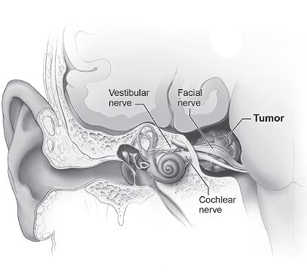
While unilateral vestibular schwannoma accounts for 8% of intracranial tumors, bilateral vestibular schwannoma often results from the genetic disorder NF2. The namesake gene NF2 on chromosome 22 codes for an important tumor suppressor protein Merlin, aka schwannomin, which regulates signaling pathways, cell growth, and adhesion3. Before Barrett et al, the loss of function of NF2 was believed to be the cause of vestibular schwannoma, but the genetic pathways and tumor cell composition were not yet fully understood. Barrett et al. attempted to better characterize VS and to identify significant associated pathways of VS tumor growth by using single-cell RNA sequencing (scRNA-seq) to examine gene expression of individual cells within the samples.
Barrett et al. discovered unexpected heterogeneity of cell types within VS tumors, heterogeneity of gene expression among various VS Schwann cells, and that VS Schwann cells resemble the Schwan cells of peripheral nerve injuries. First, they discovered the cell composition of vestibular schwannoma by clustering cells by gene expression and found 5 overarching cell classes: Schwann cells, fibroblasts, vascular cells, immune cells, and cycling (proliferating) cells.

Within VS Schwann cells themselves, they further uncovered two general types of cells: myelinating Schwann cells (myeSC) and non-myelinating Schwann cells (nmSC). Cell types were identified by grouping cells together based on similarity of gene expression. Myelinating Schwann cells (myeSC) were found by expressing typical markers of myelination, PRX and MPZ. The more prevalent non-myelinating VS Schwann cells (nmSC) were classified by expressing VS-associated genes, including S100B, SOX10, NRXN1, SCN7A, and lacking PRX expression. This finding allowed Barrett et al. to compare differences of gene expression and related pathways between VS Schwann cell types. Upon examination of gene expression patterns, VS Schwann cells showed mixed upregulation and downregulation compared to normal cells, while some cells particularly downregulated myelination markers. The heterogeneity of gene expression within cell type further proves how dysregulated gene expression leads to the complexity of discerning patterns and pathways associated with vestibular schwannoma.
Characterizing VS Schwann cells, Barrett et al. identified 7 meta-clusters of gene signatures, which found myelination, hypoxia, cell stress, interferon response, antigen presentation to immune cells, and repair-like functions. Although these gene signatures are as expected for tumorigenic cells, the immune and repair-like functions in particular will prove to be significant points of interest further in the study. While previous studies had contrasting hypotheses of either VS Schwann cells adopting de-differentiated phenotypes or resembling “repair-like” cells in acute nerve injuries, Barrett et al. resolved this ambiguity by conducting an additional study on rodents. They were particularly interested in assessing Schwann cells pre- and post-peripheral nerve injury. What they found was that VS Schwann cells closely resemble rodent Schwann cells after peripheral nerve injury based on gene expression. Additionally, they confirmed that VS Schwann cells downregulate myelination genes, upregulate repair and immune cell recruitment, and do not proliferate. Since Barrett et al. discovered that VS Schwann cells remain in non-proliferating states then prompts the question, “Which cells are then responsible for the tumor growth?” Turns out, the immune cells that were recruited then upregulate proliferation markers, disproportionately proliferate, and become significant contributors to tumor growth.
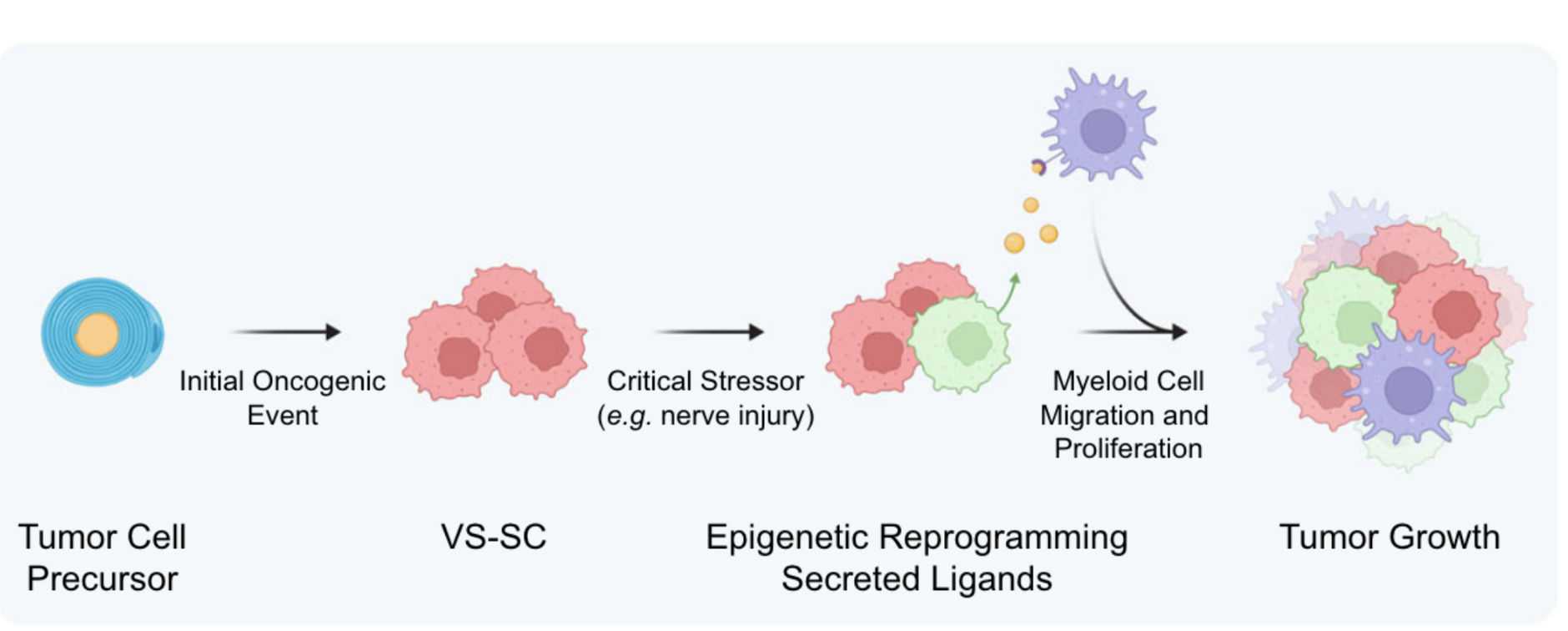
The researchers then wanted to characterize heterogeneity between samples, so they grouped samples based on gene expression similarity and found two tumor types. They identified that one tumor group was enriched for repair-like and antigen presentation (i.e. immune cell recruiter) gene expression, which they named “Injury-like” tumors, and the other tumor group “nmSC Core” expressed markers specific to non-myelinating Schwann cells. Of the two tumor types, they discovered that only “Injury-like” tumors had an increased fraction of immune cells, while “nmSC Core” did not. When assessing clinical presentations, “Injury-like” tumors were associated with large tumor sizes, while “nmSC Core” tumors were more common in patients with NF2 syndrome and were smaller in size. The discovery of these two tumor types is promising in future diagnostics and treatment developments as unique treatments can be developed depending on which genes are expressed that result in vestibular schwannoma.
Moreover, the discovery of two tumor classifications allows researchers to further study these tumor types separately and may explain differing clinical presentations of VS tumors. Characterizing Schwann cells and tumor types prompts further research to develop therapies unique to its gene expression analysis. One limitation of the study is the potential over-interpretation of cell type clustering using UMAPs. While UMAP is a useful tool in visualizing data by identifying and amplifying differences between cells’ RNA, this may lead to the assumption of distinct cell type populations, when cell types may be more similar than implied by UMAP. Another limitation is that only 15 VS samples were sequenced and were limited to only sporadic VS. Although novel classifications for cell and tumor types were identified, further studies with more samples and diverse clinical presentations are needed. Since the “Injury-like” tumor type was only discerned from a nerve injury study on rodents, this extrapolation is currently correlational and cannot be replicated in patients due to ethical concerns. Future studies could attempt to alleviate this ambiguity by studying existing peripheral nerve damage in patients and recruiting such patients for transcriptome sequencing.
References
1. Vestibular Schwannoma (Acoustic Neuroma) & Neurofibromatosis | NIDCD. https://www.nidcd.nih.gov/health/vestibular-schwannoma-acoustic-neuroma-and-neurofibromatosis (2017).
2. Barrett, T. F. et al. Single-cell multi-omic analysis of the vestibular schwannoma ecosystem uncovers a nerve injury-like state. Nat Commun 15, 478 (2024).
3. Petrilli, A. M. & Fernández-Valle, C. Role of Merlin/NF2 Inactivation in Tumor Biology. Oncogene 35, 537–548 (2016).
Author: Lizabella Nadelson
Contact: linadelson@davidson.edu
© Copyright 2022 Department of Biology, Davidson College, Davidson, NC 28036.

I find it interesting that the proposed limitations of this study are quite common throughout many of the current studies implementing RNA sequencing. I agree with your statement that these algorithms tend to possibly overestimate the clustering of cell types, possibly amplifying differences which aren’t seen within real biological systems. Similarly, these studies may be over simplifying the homogeneity of these systems. With small sample sizes and lack of diversity between donors, it is hard to truly discern the causation and full function of the genetic pathways. I think it would be interesting to see this study done in other model organisms with similar functioning schwann cells and nerve pathways. This data could be interesting to compare between ortholog genes.
Hi Lizabella, thanks for the nicely written article. The authors’ findings on the establishment of the tumor microenvironment are very interesting. I am a little unclear on exactly which kinds of immune cells are recruited to the tumor. Is it just myeloid cells, or are there others (and did the authors even look for others)? Did they find any Tregs at the tumor site? It would also be interested to know specifically which antigen presentation genes were differentially expressed, and whether they were upregulated/downregulated.
I agree that this study needs to be replicated in other model organisms and ideally humans. These scRNA-seq papers are pretty good for hypothesis generating, but I definitely would be interested in follow-on studies. It would be interesting to conditionally knockout some of the antigen-presentation genes to see if the immune cells still contribute to tumor growth.
The way you put together the information on your posts is commendable. I would highly recommend this site. You might also want to check my page UY9 for some noteworthy inputs about Website Promotion.