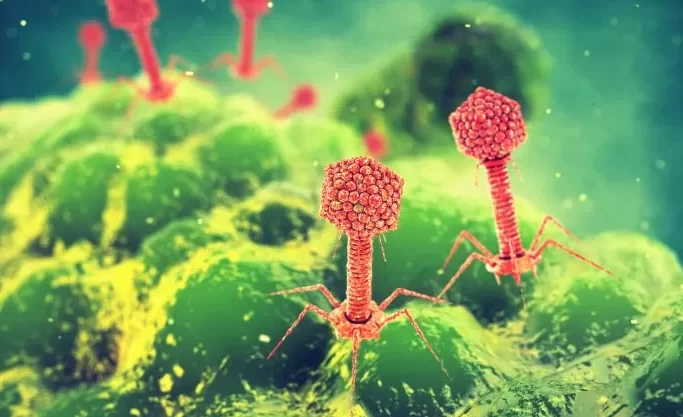
Scientists have adapted existing technology to understand the interactions between the proteins on the surface of pathogenic viruses and the proteins on our body’s cells that allow infection to establish successfully.
Disclaimer: “This web page was produced as an assignment for an undergraduate course at Davidson College.”
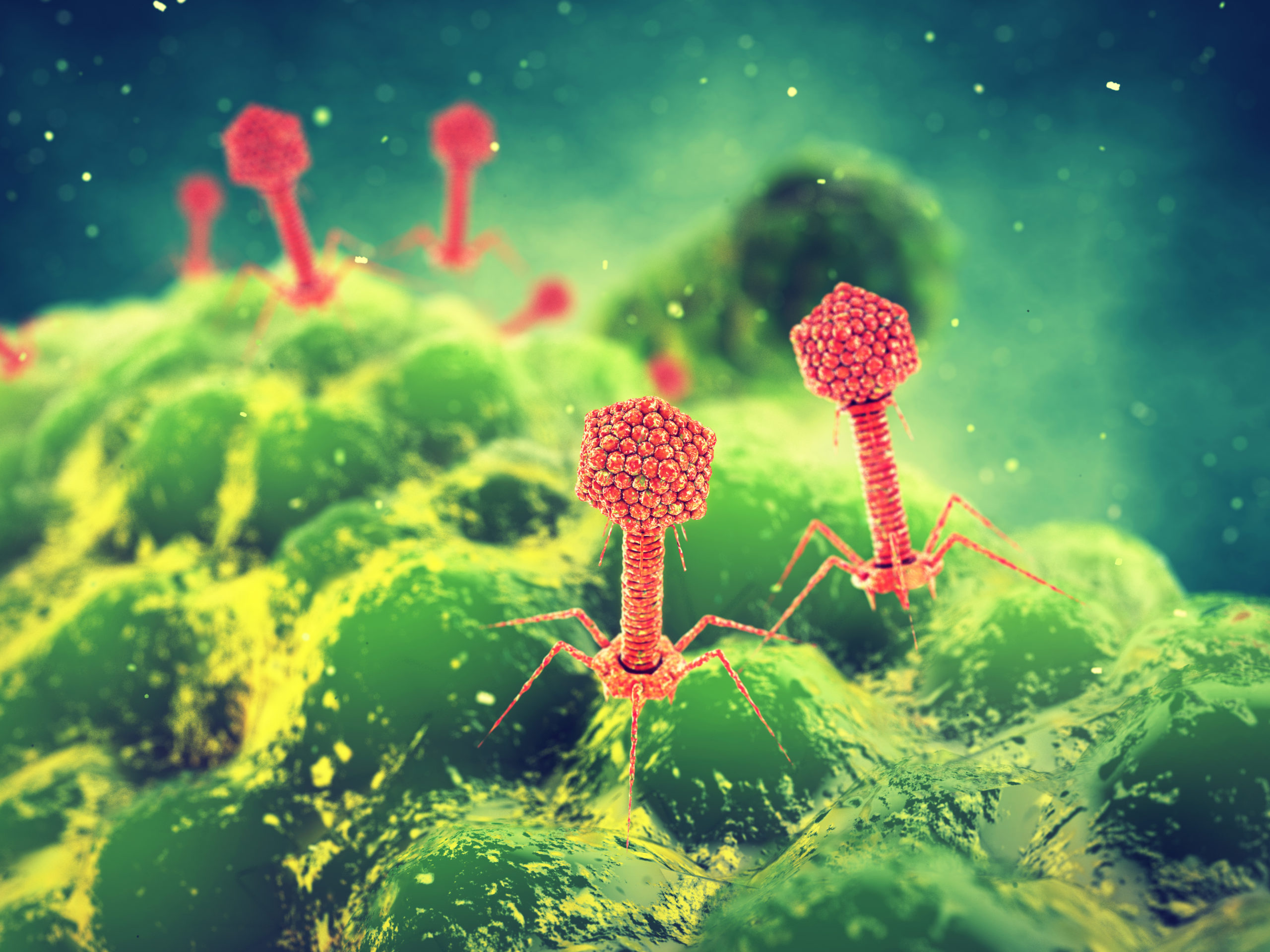
Jumbophages on the surface of a host cell are ready to infect the host and hijack the cell’s replication mechanisms (Birkholz, 2023).
Understanding the mechanism through which viruses infect our body and cause illness is essential to the development of new therapeutic approaches to combat pathogens resistant to current treatment approaches. However, until recently, the available technology and software analysis tools could only study very small viruses and those that express a small quantity of proteins. Larger, more complex viruses, like HIV and SARS-CoV-2, were of greater interest for research, but the available methods for investigating protein-protein interactions were too tedious and labor-intensive to perform for viruses with large genomes and provided false positives and noisy data (Gingras et al., 2007; Tian et al., 2017). This meant that research in this field was limited and of lower quality than desired. To understand the mechanisms of infection and viral replication, researchers must be able to sequence the part of the genome that codes for proteins and how the proteins will interact with extracellular elements, called the proteome.
In a recent report, Fossati et al. adapted existing technology and analytical tools to study the protein-protein and host-pathogen interactions (Fossati et al., 2023). Their goal was to understand how Jumbophages re-wire P. aeruginosa protein complexes to successfully infect the host by evaluating differences in size-exclusion chromatography profiles after the bacteria were exposed to the virus. They used a technique, known as size exclusion chromatography mass spectrometry, to separate large molecules, in this case proteins, by their size and molecular weight and obtain other information about the molecules. With this method, it will be possible to identify the viral and bacterial proteins and how they interact with each other. Their new method was validated by high coverage of the bacterial and phage proteome and coincided with pre-existing validated data. Fossati et al. performed several tests to obtain additional information about the bacterial protein complexes and form a comprehensive and valuable dataset produced by their new technique. This allowed them to be sure that the data would be valuable, comprehensible, and valid. The experiment was meant to model the way that people are exposed to viruses in their daily lives and face the possibility of catching a viral infection. To account for unexpected viral proteins already present within the bacteria and avoid misattributing them to the phages of interest, they performed a parallel experiment with a strain of the same bacteria that’s resistant to both phages. create a new technique that overcame the previous limitations. With this experiment, researchers were hoping to innovate new existing methods and understand how viruses hijack an organism’s proteome at a molecular level.
One of the most important findings of this study was the discovery of conserved and divergent predation mechanisms in the viral proteome. In this study, researchers sought to quantify the situations that would produce a difference in the size-exclusion chromatography profile, so they compared the size-exclusion chromatography profiles of the infected bacteria and the control (resistant) strain to identify the bacterial proteins that are modified after infection by either phage, of which they found 600. After reviewing a whole-cell lysate, they also found that protein abundance changes at the assembly state level do match the protein abundance at the global proteome level. The consistency in the number of affected proteins altered after infection between both phages shows a possible degree of conservation in the mechanisms the phages use to attack the host organism. Further analysis revealed an altered abundance of certain proteins related to the formation of biofilm. For a pathogenic phage, disturbing the abundance of proteins that build and repair the cell envelope would be essential to penetrating the host organism effectively. Fossati et al. continued to study the viral proteome of the phages to identify and organize protein complexes and discover undescribed proteins using the size exclusion chromatography mass spectrometry methods.
A study like the one by Fossati et al. can have a multitude of benefits for the medical community. Understanding the mechanisms that drive the interactions between host and pathogen before, during, and after infection as well as the progression of infection will be key in the application of this concept in human models. Further insight could serve as the foundation for the development of new treatment approaches that target the host-pathogen interactions that allow the pathogenic virus to infect the cell and the infection to progress. Innovating existing technology is also extremely beneficial for this field of study and could be applied to other research areas facing similar challenges and limitations.
References:
Birkholz N., 2023 Interactions between bacteria and phages. Bioprotection Aotearoa.
Fossati A., Mozumdar D., Kokontis C., Mèndez-Moran M., Nieweglowska E., Pelin A., Li Y., Guo B., Krogan N. J., Agard D. A., Bondy-Denomy J., Swaney D. L., 2023 Next-generation proteomics for quantitative jumbophage-bacteria interaction mapping. Nature News.
Gingras A.-C., Gstaiger M., Raught B., Aebersold R., 2007 Analysis of protein complexes using mass spectrometry. Nature News.
Tian B., Zhao C., Gu F., He Z., 2017 A two-step framework for inferring direct protein-protein interaction network from AP-MS data – BMC Systems Biology. BioMed Central.
News and Views by: Andrea Morales Correa, anmoralescorrea@davidson.edu
Primary Article: Next-generation proteomics for quantitative Jumbophage-bacteria interaction mapping
© Copyright 2022 Department of Biology, Davidson College, Davidson, NC 28036.

0 thoughts on “Hacking the viral proteome to block infection progression”